
What happens to a thirty-piece order
Thirty pieces is our minimum. Here is every stage one of those orders passes through, and why the small runs get the same attention as the large ones.
· 4 min read · Minimalistic Garments · Process
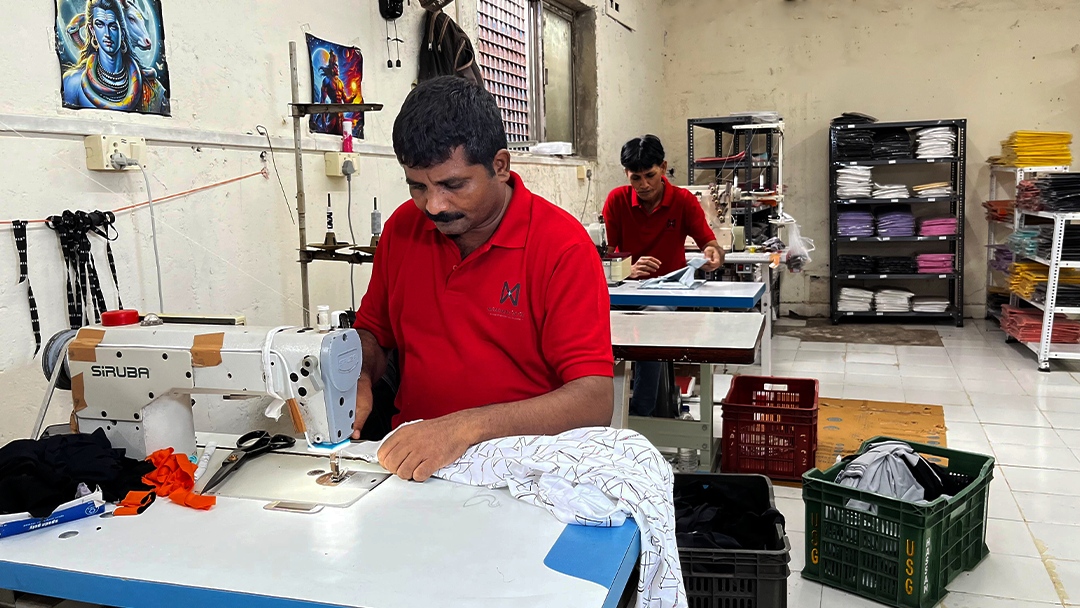
Thirty pieces is the smallest order we take. It is also, quietly, the order we think about most — because it is almost always somebody's first.
A brand ordering three thousand units has usually done this before. They know what a tech pack is, they know what GSM they want, and they have a fair idea of what will go wrong. A brand ordering thirty is often finding all of that out on your order. So here is the whole thing, stage by stage, with nothing skipped.
Before anything is cut
The first conversation is not about garments. It is about what you are actually trying to make, who is going to wear it, and what you can spend. Those three answers decide almost everything that follows.
Out of that conversation come four things: the fabric and GSM, the fit, the print technique, and a date. All four are written down and shared with you before a single metre of cloth is touched. If the number does not work for you, this is the cheap moment to find out — not after the fabric has been cut.
This is also where we will sometimes talk you out of something. If your artwork has fine detail that screen printing will lose, we will say so. If a heavier GSM is going to price you out of your own market, we will say that too. Recommending the more expensive option every time is an easy way to lose a brand after one order.
Choosing the base
Blanks are not a commodity, whatever the price lists suggest. The fabric decides how the garment falls, how the print sits, and whether it still fits after the first wash.
We work with pre-shrunk fabrics across multiple GSMs and over twenty colours. Pre-shrunk matters more than it sounds: an un-shrunk cotton tee can come back from a first hot wash noticeably shorter, and the customer does not blame the fabric. They blame your brand.
Turning artwork into something printable
There is a gap between a design that looks right on screen and a file that will print cleanly onto cloth, and closing that gap is its own job. Placement, sizing, colour separation, and the small corrections that stop an edge going muddy — that is what happens between your file and the press.
You get a mockup back. Nothing goes forward until you have looked at it and said yes.
Choosing how it gets printed
We print by screen, puff, HD, DTF and sublimation, and the honest answer is that none of them is best. Each one is best at something.
Screen printing is unbeatable on flat, bold artwork at volume. Puff gives you raised texture. HD holds fine detail. DTF handles full-colour artwork and complex gradients without a separate screen per colour, which is often the right call at thirty pieces. Sublimation works on the right synthetics and goes into the fabric rather than onto it.
Raj, who runs our printing, has been doing this for twenty years. The value of that is not that he can operate the machines. It is that he can look at your artwork and tell you which machine it should go on.
Cutting and stitching
This all happens on our floor, in Ghatkopar East. Nothing is sent out to a subcontractor, which is the single reason we can hold the dates we quote — there is no third party whose queue we are sitting in.
Umesh has been cutting patterns for thirty years. Watching him work is the clearest argument we know for keeping production in-house: he catches a fit problem in the pattern, before it becomes thirty identically wrong garments.
Quality is checked at three stages rather than once at the end. Catching a problem at stage one costs a piece. Catching it at dispatch costs the run.
Knowing where it is
Every order moves through Saarvik, the production system we built ourselves. Each stage gets marked off as it completes.
The reason we built it is unglamorous: "where is my order?" is the most common question any manufacturer gets asked, and in most of this industry the answer is a guess dressed up as a date. We wanted a real answer. Now when you ask, we can tell you which stage your pieces are sitting at and what happens next.
Finishing, packing, and out
Tags, labels, inserts, and the box. This is the part your customer actually touches first, and at thirty pieces it is also the cheapest place to look like a much bigger brand than you are.
Then it ships — across India or abroad — with tracking.
Seven to twelve working days
That is the production window, counted from sample approval. It is quoted before we start rather than revised while you wait.
Thirty pieces will not make anyone's month. But it is how almost every brand we work with now started, including several who are ordering in the thousands today. That is the entire argument for a low minimum: it lets someone find out whether the thing sells before they bet on it.
If you have an idea and no idea what it costs, that is a normal place to start from. Send us the sketch.