
Why we're in Mumbai
You can make garments more cheaply elsewhere in India. What you cannot do elsewhere is fix a problem the same afternoon it appears.
· 4 min read · Minimalistic Garments · Story
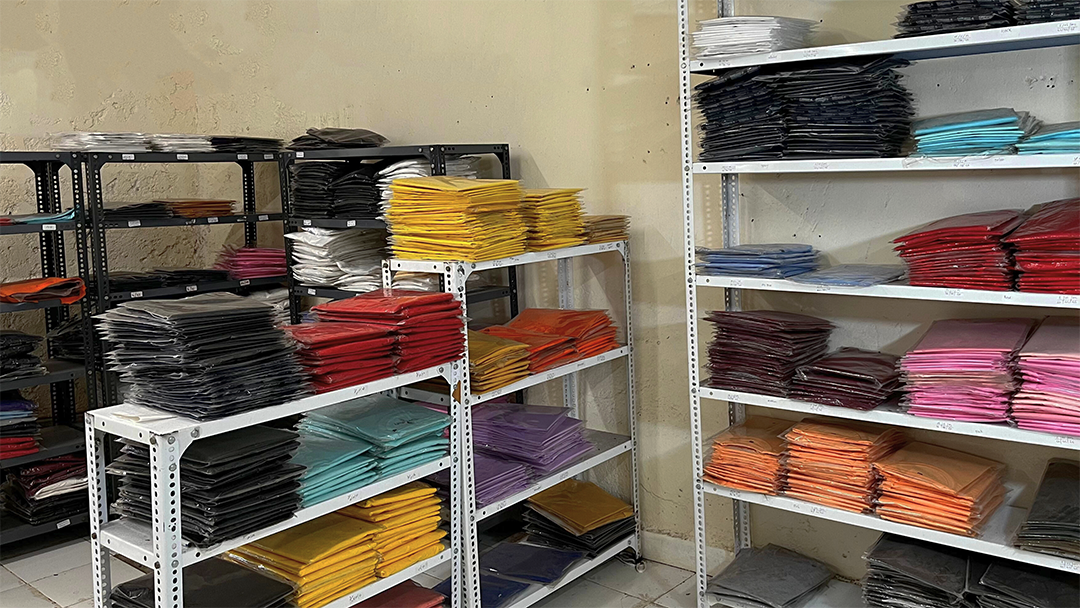
We are in Ghatkopar East, in the eastern suburbs of Mumbai. Gala No. 2, first floor, opposite a temple, off 90 Feet Road.
It is a reasonable question why. Mumbai is not the cheapest place in India to run a production floor — not for rent, not for labour, not for anything. There are cities where the same unit would cost meaningfully less to operate, and plenty of manufacturers have made exactly that move.
Here is what staying in the city actually buys, and why we think it is worth paying for.
Problems are solved in hours, not weeks
Garment production goes wrong in small, boring, urgent ways.
A trim supplier sends the wrong shade of thread. A batch of labels arrives with a typo. You need forty more metres of a fabric mid-run because the cutting efficiency came out worse than planned. A zip pull is subtly the wrong size and the whole thing looks cheap.
None of these are disasters. All of them are disasters if the fix takes two weeks. In a city with a dense supplier ecosystem, someone can go and get the right thread today and the line is moving again by afternoon. Somewhere with thinner supply, the same problem becomes a courier, a delay, and a conversation with you about a date we no longer control.
Most of what people experience as "the factory is unreliable" is really this: the factory is far from its own supply chain, and every small problem becomes a schedule problem.
Being here is what lets us quote seven to twelve working days and mean it.
You can come and see it
This is the part we would not give up.
When someone asks whether they can visit the unit, the answer is yes, and it is yes without any preparation on our side. We are reachable — you can be here on a weekday and watch your own order being stitched.
That matters more than it sounds. Garment manufacturing runs on trust that is almost always extended blind. You send money to a unit you have never seen, on the word of a WhatsApp conversation, and hope that the thing that comes back resembles what you described. Most brands never see the floor their clothes are made on. Some never learn which country it is in.
Being in a city most of our clients can reach in an afternoon turns that from a leap of faith into a visit. Almost everyone who comes stays longer than they planned to, usually standing over the cutting table asking questions.
We would rather be the manufacturer you have stood inside than the one with the better price per piece.
The people are the actual reason
Umesh has been cutting patterns for thirty years. Raj has been printing garments for twenty. That is fifty years of judgement between two people, and it is not something you can hire quickly or move somewhere convenient.
Mumbai has been a garment town for a very long time, and the practical effect is that skill like that exists here in a depth that is hard to replicate. The value is not that Umesh can operate a cutting table — plenty of people can. It is that he looks at a pattern and sees the fit problem while it is still paper, before it becomes three hundred identically wrong garments.
You do not get that from equipment. You get it from someone who has already made the mistake, years ago, and remembers.
What it costs us
We should be straight about the trade-off, because there is one.
Our overheads are higher than they would be elsewhere. Space in Mumbai is expensive and it is not getting cheaper. That cost is real and it is in our pricing, and any manufacturer telling you otherwise is either subsidising it or cutting something you cannot see.
What we get for it is control: over dates, over quality, over the ability to fix things quickly, and over whether a client can walk in and look.
If your only criterion is the lowest possible price per piece, we will not be the cheapest quote you get, and we will usually say so early rather than waste your time.
If what you want is a garment that comes back the way you approved it, on the date you were told, from people you can go and meet — that is what the city is for.