
The people on the floor
Seventeen people make everything that leaves this building. Automation gets the credit in most manufacturing stories; here the credit belongs to two people with fifty years between them.
· 5 min read · Minimalistic Garments · Story, People
Six thousand garments a month sounds like a machine did it.
It did not. Nine people stitch, four check quality, two iron and pack, two run the printing. Seventeen in total, plus the handful of us who talk to clients and keep the numbers straight. That is the whole operation.
We think it is worth writing down who actually does the work, because in most manufacturing the people are invisible by design — the brand is the story and the floor is a black box.
Umesh, who sees it before it exists
Umesh Chand Gautam is our line master. He has been cutting patterns for thirty years.
The best way to explain what that is worth: a fit problem can be caught at three points. On paper, when the pattern is drawn. On the first sample, when one garment exists. Or at dispatch, when three hundred identically wrong garments are folded in boxes.
Catching it on paper costs an hour. Catching it at dispatch costs the run, the date, and usually the client.
Umesh catches it on paper. He will look at a pattern, and without measuring anything, say that the shoulder will sit wrong on the larger sizes. He is generally right. Nobody has worked out how to buy that.
It is also the clearest argument we have for keeping production in-house. Outsource the cutting and you outsource that judgement, and you find out what it was worth about three hundred garments too late.
Raj, who knows which machine your artwork belongs on
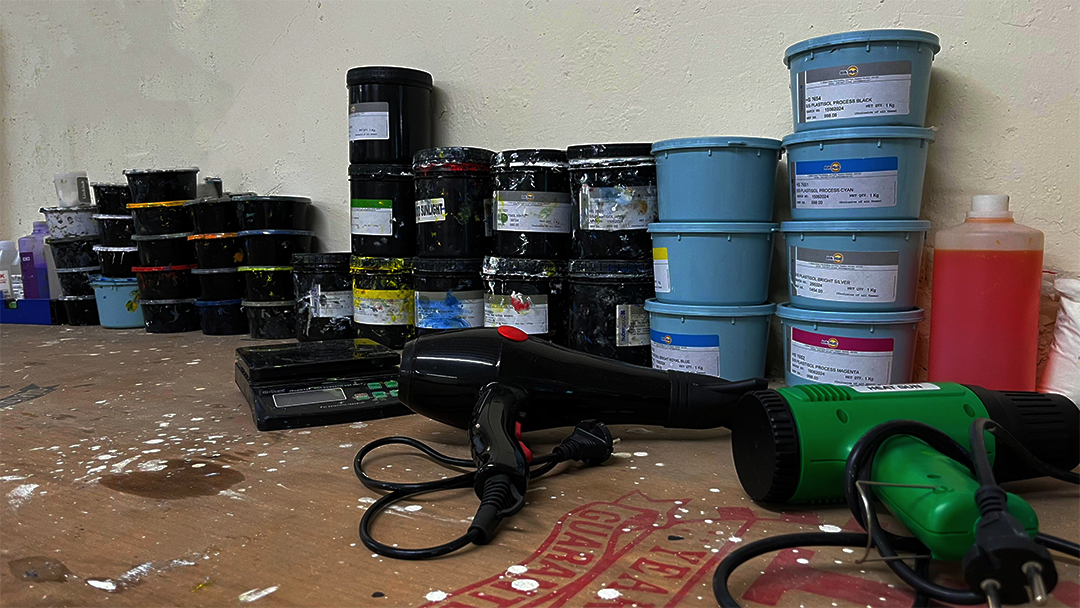
Raj Vishwakarma runs printing, and has for twenty years.
There are five techniques in this building: screen, puff, HD, DTF and sublimation. The valuable thing about Raj is not that he can operate all of them. Plenty of people can operate them.
It is that he can look at your artwork and tell you which one it should go on — including, quite often, that the cheaper technique is the right answer. Fine detail that screen printing would lose. A gradient that needs DTF because separating it into screens would cost more than the run is worth. An all-over pattern that only sublimation can do, and only on the right fabric.
A brand usually arrives having already decided they want screen printing, because screen printing is the one they have heard of. Raj is the person who says: not for this design, not at this quantity.
The four who look for problems
Quality control is four people, and they check at three stages rather than once at the end.
Checking once at the end is the industry default and it is the wrong way round. By the time a garment is finished, everything that went into it has already been paid for. Finding the fault there means the loss is total.
Checking at three stages means a fault costs a piece, not a run. It is slower. It is also the difference between a batch you can ship and a batch you have to explain.
Their job is essentially to be unwelcome — to find the thing everyone else missed and send it back. A good QC team makes the rest of the floor's day slightly worse and the client's month considerably better.
The two nobody thinks about
Two people iron and pack.
This is the least glamorous job in the building and one of the most consequential, because it is the only part of our work your customer experiences directly and immediately. Everything else — the pattern, the stitch, the print — they take on trust. The fold, the tag, the way it sits in the box: that is the first physical impression of your brand.
A well-made garment badly packed reads as a badly made garment. Nobody separates the two.
Karna and Mamta
Karna is the founder. NIFT, then a decade of learning the parts NIFT does not teach — washing, dyeing, finishing, and what happens when a supplier lets you down. He is generally the person you talk to first, and the one who will tell you a heavier GSM is going to price you out of your own market.
Mamta was a financial advisor at CIBC in Canada before this. She decides whether the numbers work — which, in a business built on a thirty-piece minimum, is a harder question than it looks. Low minimums are easy to advertise and difficult to survive.
Viraj, and the thing on the screens
Viraj is our CTO and built Saarvik, the system every order moves through.
Before it existed, "where is my order" was answered from memory, or from a whiteboard, or by walking over and looking. That works at a certain scale and then stops working, usually without warning.
Now every stage gets marked off as it completes, which means when you ask, we can tell you which stage your pieces are sitting at and what happens next. It is not a glamorous piece of software. It is just the difference between an answer and a guess.
Why we are telling you this
Because when you place an order here, this is who makes it.
Not a facility, not a partner network, not a capacity figure on a website. Umesh cuts it. Raj prints it. Four people check it three times. Two fold it into the box.
That is also why the minimum is thirty pieces and not five hundred. Seventeen people can give thirty garments genuine attention. It is a size we chose.